Blog Post 2: August 13th
The second creation account emphasizes knowledge and the tree of knowledge in order to effectively juxtapose good and evil. Knowledge is so heavily communicated throughout this account because the account as a whole describes a human’s constant state of free will with both good and evil decisions. The catalysts in making these decisions and the underlying factor of all free will is knowledge. The second creation account is depicting this struggle of balance and how knowledge drives all free will. According to Legaspi, the eating of “the tree of the knowledge of good and bad” is the entrance of evil into the human free will. While free will existed before the consumption from the tree, this was the first evil act of free will and thus symbolizes the nature of a human’s being and free will: both good and evil. The act was eating and not some other activity because eating is a self-promoting action that benefits no one but yourself. It makes the act of taking the forbidden fruit to another level because it was for self-pleasure. Touching or looking at the special object aren’t on the same level of selfishness. A tree from which to eat was used because nature is a gift from God and by stealing from a tree is still from a gift from God.
Post 2: August 13th
The second creation account emphasizes knowledge and the tree of knowledge in order to effectively juxtapose good and evil. Knowledge is so heavily communicated throughout this account because the account as a whole describes a human’s constant state of free will with both good and evil decisions. The catalysts in making these decisions and the underlying factor of all free will is knowledge. The second creation account is depicting this struggle of balance and how knowledge drives all free will. According to Legaspi, the eating of “the tree of the knowledge of good and bad” is the entrance of evil into the human free will. While free will existed before the consumption from the tree, this was the first evil act of free will and thus symbolizes the nature of a human’s being and free will: both good and evil. The act was eating and not some other activity because eating is a self-promoting action that benefits no one but yourself. It makes the act of taking the forbidden fruit to another level because it was for self-pleasure. Touching or looking at the special object aren’t on the same level of selfishness. A tree from which to eat was used because nature is a gift from God and by stealing from a tree is still from a gift from God. The failure of Eve and Adam isn’t just disobedient it’s an active exercise of their free will against God in the first act of free will evil. It shows that we can use our free will to do as we please but that alone doesn’t justify our actions. Yes, eating from the tree makes Eve and Adam more God-like in knowing good and evil. Its merciful for God to banish them because before Adam and Eve only knew what was good and not what was evil but now they had known evil, they needed to be slightly separated from God to fully understand the power of good.
UW-Madison Writing Center
XFL Vlog
A Credible Communicator
The Credible Communicator reflects the importance of good communication. A good communicator is able to get their point across in an effective and intentional manner. They are able to use their skills to build trust and reliability with a person and ultimately convey and persuade the information they’d like to portray. The first and perhaps most important advice given is presentation. The article uses Allen Ginsberg, a poet, as an example. Ginsberg appeared on a late-night talk show looking very sloppy. He had a wild beard, a tight unappealing tie-dyed shirt with holes, and seemingly neglected to take care of himself. As a result, the information he attempted to convey on the show wasn’t taken seriously and his ability as a communicator was harmed. This is important for my podcast because it shows that a more professional, better sounding and overall well-presented podcast has a significantly more influential impact on the listener. In a professional field, it shows the importance of presentation in presenting information and being argumentative. Another major contributor to the effectiveness of a communicator is their credibility. Scientific studies have shown that the credibility and reputation of people is very influential. Often times a person’s credibility triumphs over any argument or information when people make decisions and decide to fully listen. Building strong credibility and establishing a good preconceived image is very important as it fully transforms the way people think about you. The article depicted this by describing a study done on race. The study discovered that people with prejudice against black people found arguments delivered by black people significantly less influential and effective. A person’s preconceived notion about race significantly affected their image of the argument. This reveals to us that a preconceived image of someone is greatly impactful in one’s ability to influence and communicate. This can relate to my podcast because I can establish credibility and use it to my advantage in better communicating to my audience. Additionally, in my professional life this taught me the importance of maintaining a strong, credible reputation.
Who am I? Blog Post #4
The summer going into my senior year of High School, I was extremely busy with football and my job in a research lab. Every day I had team lifts and practice for hours, which I balanced with my work in the lab. During the summer, it felt like I was living two completely separate lives. In the lab I was surrounded by intellectuals that were giving their lives to research and the pursuit of cutting-edge knowledge. On the other hand, before and after I entered this extreme academic environment I would be at practices and lifts surrounded by people on the other side of the spectrum. From the locker room shenanigans to the meathead lifting attitudes of my football teammates, my experiences and lives in these two completely different worlds were drastically different. In addition, during this time I was beginning my college applications. I decided to apply to sixteen colleges (six of which were University of California schools that had the exact same application) and nearly every school’s application had an essay prompt on personal identity. Intimidated by these large, daunting questions I realized I had never pondered or investigated my identity before and I entered a period of personal reflection. I was becoming very confused about my identity and who I was during this time because I felt like a different person in the two distinct worlds of academics and sports. I was very academic, focused on obtaining knowledge and motivated in a scholastic career in the lab. But in on the football field I was far less uptight, driven for physical success and ultimately very jock-ish: never once thinking about academics or research. This caused me and my perception of my personal identity to be torn between these two identities- as if I had to be one or the other. After bouncing back and forth between these two identities I came to the realization that I wasn’t either of the two, but rather a blend. At the heart of my identity laid an eagerness to improve myself, whether its intellectually or physically, and both the research I was conducting as well as my pursuit in football were fulfilling this desire. Overall, I learned that my identity spans across many stereotypical identity roles.
Playing High School Football?
Football played an essential role throughout my high school experience. It’s the way I formed my strongest friendships, it fulfilled my competitive athletic desire and was overall a large source of happiness throughout my high school years. Football truly was the highlight of these four years. So, when my little brother, Matthew, began his high school career doubting whether or not to play football I felt obligated to persuade him into playing. My strategy in convincing him was first, to explain to him all the benefits and great things football gave me in all spheres of my life. I wanted to tell him personally why football was so important to me and what I personally gained. I explained to him how football set me up socially in building strong relationships which was especially helpful as a freshman starting high school. I told him how football tested my physical limits, whipping me into great shape and setting me up to physically compete at a level I never thought possible for me. Finally, I explained to him how personally football shaped my character and helped me grow into a more driven, disciplined and selfless person. My approach for persuasion was to highlight how significant football was in three very different and important spheres of life- socially, physically and personally. Also, I wanted to focus on my personal experience because he and I are very similar people and I wanted to show him that if I reaped all these benefits, he could too. This approach proved to be very affective as he not only played football but was eager to tryout and be a part of the team. Looking back, I feel I could have been more specific with exactly how football benefited my life. For example, instead of just saying ‘I formed strong relationships with my teammates’, I should have also included specific examples such as how I met and befriended my best friend, Will, on the very first day of tryouts. My approach incorporated ethos as I know he looks up to me as his brother and I also had the experience of playing football which built my credibility around the subject. I laid out a fairly strongly logos driven argument as I logically walked through exact evidence on how his life would be improved if he played. Finally, I used pathos when I described my own personal experiences where he emotionally connected and felt intrigued to join.
Vlog on Social Media Use
Controversial Cover
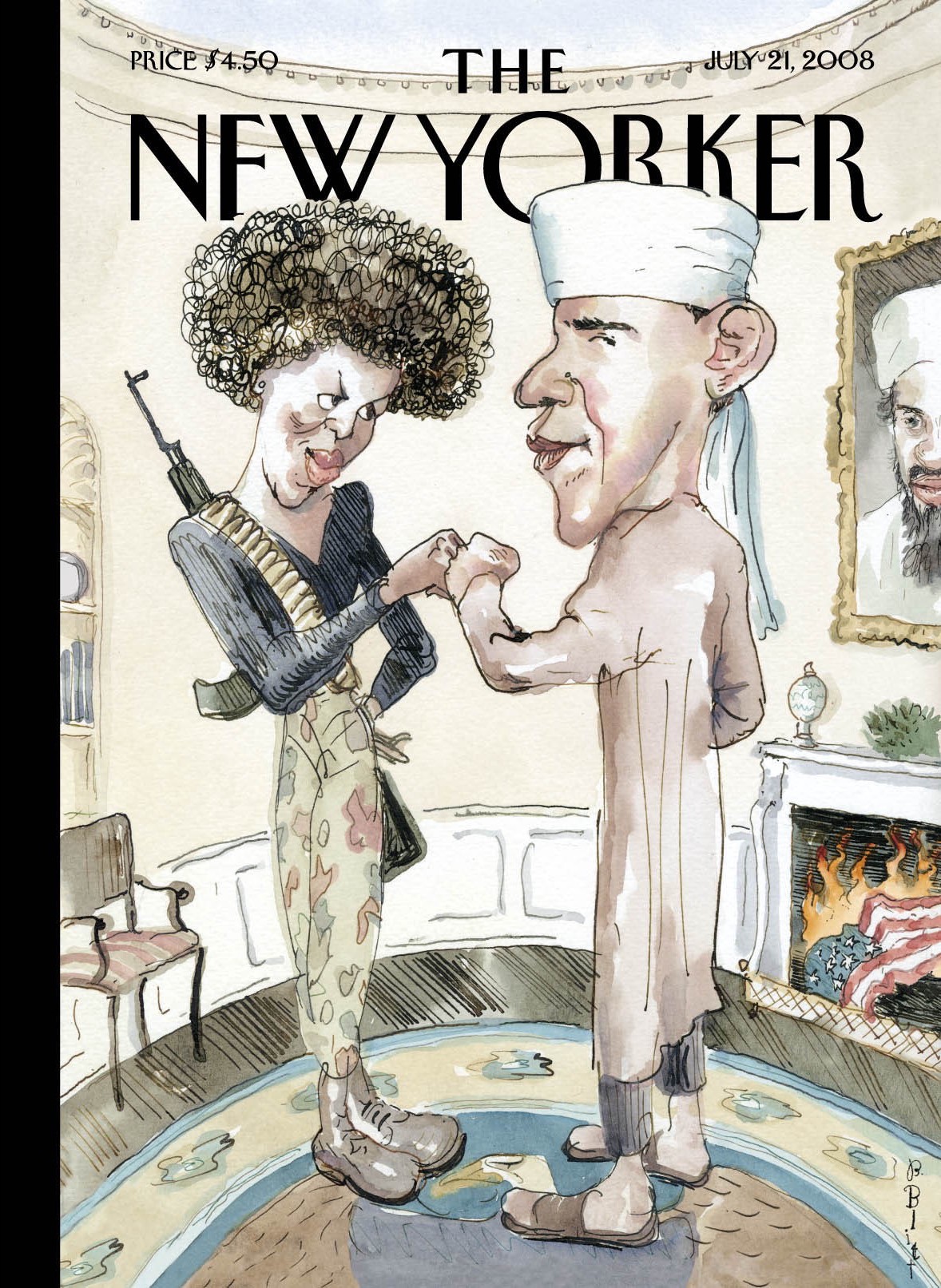
This New Yorker magazine cover is perhaps one of the most controversial New Yorker covers of all time. It depicts Barack Obama and his wife, Michelle Obama, dressed in clothing often associated with Al-Queda, holding guns, and fist pumping in front of the American flag burning in a fire. The historical time period, or Kairos, of the cover is during the 2008 presidential election when Obama was running to be president. While he was running, many false rumors surfaced on how Obama was supportive of terrorists, that he wasn’t fit to be president and that he even hated America. Further, the artist uses a pathos strategy of humor to make an appeal to the viewers emotions through comedy. The cover is depicting the theme in an exaggerated and parody manner that by taking it to the extreme actually mocks these very rumors. In particular, the artist draws a portrait of Osama Bin Laden in the Oval office- a humorous exaggeration on the belief the Obamas are supportive of him. Additionally, the artist makes an appeal to Ethos by the tone and style he depicts the Obamas. The picture is drawn in a cartoon fashion where many features, such as the size of their faces, are greatly exaggerated. This expresses to the views not to take the picture too seriously and that rather it is a comedy cartoon. If I were in charge, I would have chosen to publish this image because it provokes thought and puts an emphasis on the claims Americans had against the Obamas. By depicting the Obamas this way, the picture aims to challenge these ideas and misconceived rumors. I think there would have been immense public backlash because people would be offended by the depiction, but it would spark a conversation about how serious and outrageous many political claims can be.
 Jack Kirkham's Writing Blog